


The parasitic fly has re-entered the US after 50+ years of eradication.
RAPID
RESPONSE
- Screwworm found in Mexican avocadoN+ · 2h
- Active screwworm cases fall 35.8% in Sonora; state ranks 13th nationallyEl Sol de México · 2h
- United States will maintain imports of Mexican cattle despite screwworm casesPotosinoticias.com · 3h
- Bury 52 tons of avocados in Michoacán over screwwormMVS Noticias · 3h
- Chihuahua begins the week first nationally in screwworm casesPausa.MX · 4h
- Producers destroy tons of avocados from Jalisco, Colima, and Nayarit upon detecting screwworm pestTelediario · 4h
- Screwworm alert in avocados: why larvae invade the fruit's pitDebate · 4h
- Lawmaker warns of screwworm threat in Sinaloa, proposes 5-point comprehensive strategyViva la Noticia · 5h
- Chihuahua reports 130 active screwworm cases at end of OctoberSegundo a Segundo · 7h
The screwworm is back.
Loading the live map.
U.S. active animal cases
25
79 confirmed U.S. cases on record
As of November 2, 2026
Mexico active animal cases
1,958
in 30 states
As of October 31, 2026
Human cases, Mexico
689
in 2026 · 9 deaths · 26 new this week
As of October 23, 2026
Total animal cases, Central America and Mexico
209,400+
regional animal cases
As of October 29, 2026
- Updated in the last 7 days
- 8 to 30 days old
- More than 30 days old

The sterile fly gap
SIT has always been the answer. The challenge is production at the speed the outbreak requires.
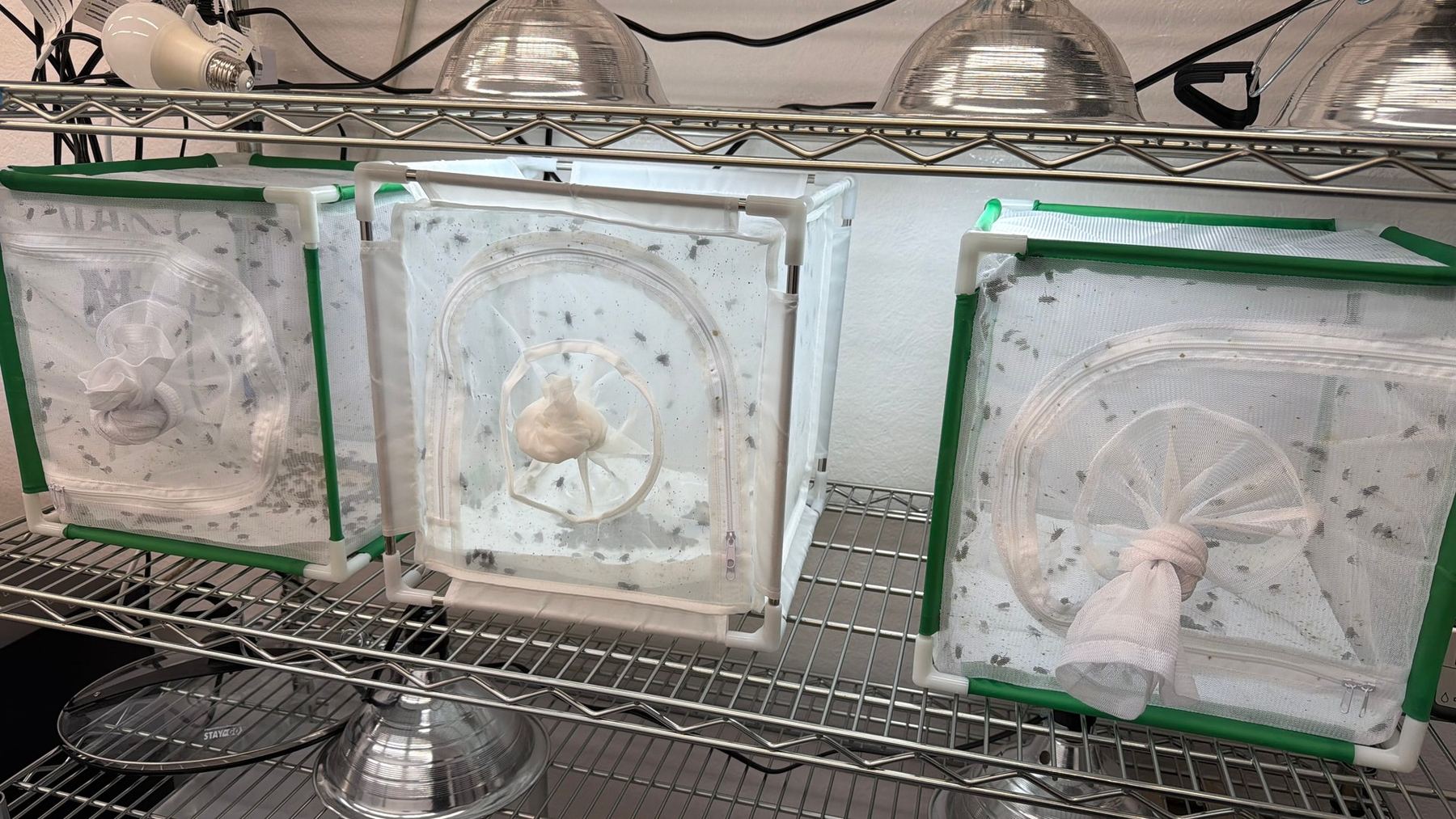
Inaugurated in 2006, COPEG maintained the North American screwworm barrier, releasing approximately 20 million sterile flies per week at the Panama-Colombia border. COPEG now produces 100 million sterile flies a week at outbreak level.
USDA committed $21 million to retrofit a fruit fly production facility in Metapa, Mexico, targeting an additional 30 to 60 million sterile flies per week. USDA states that containment needs up to 500 million a week.
M3's modular protocol targets 100 million sterile flies a week. Twenty-five million a week within nine months of activation, 100 million within 12, subject to activation and licensing.
Additive, not competitive
M3 is additive to the national response, not a competitor to it.
- $1M DOE grant to develop rapid-response SIT
- Multiple USDA APHIS PPQ permits
- Working with USDA APHIS since 2013
- APHIS Small Business Contractor of the Year, 2017
Rapid-response capacity
We aim to produce 100 million sterile flies a week within 12 months of activation.
Our field-deployable protocol uses commercially available X-ray irradiators. No cobalt-60 source enters the production chain.
Genetic modification, like a gamma source, brings significant regulatory complexity. X-ray SIT uses neither and cuts through that red tape.
X-ray SIT
- Radioactive source
- No
- Genetic modification
- No
- Regulatory complexity
- Low
- Field validated
- Yes
What is at stake
Testimony before the Texas Legislature put that state’s exposure at $13.4 billion across livestock, wildlife, and adjacent industries.
Texas holds roughly 13 percent of the nation’s cattle herd. An incursion forces prevention programs and treatment protocols across ranches and feedlots, and even a contained outbreak consumes regulatory resources and disrupts market confidence.
White-tailed deer tell the wildlife story. Before eradication the fly held the herd under 1 million animals. Today it exceeds 5 million, and Texas deer alone support a hunting economy worth $9.6 billion a year.
Eradication saves North American producers about $1.3 billion every year. Each gap in the barrier across Mexico and Central America holds a source population that can re-invade.
Sources: testimony before the Texas Legislature, 2025; USDA APHIS.
A One Health threat
The screwworm crosses species lines. It infests cattle, horses, sheep, goats, swine, pets, wildlife, and people.
Livestock and companion animals. Infestation cuts productivity, triggers trade restrictions, and raises prevention and treatment costs. Pets and other companion animals carry the same risk.
Wildlife. In the 1960s, outbreaks in Texas killed 60 to 80 percent of white-tailed deer. Deer and feral hogs range widely, and their wounds are harder to find than cases in penned livestock.
People. Human infestations are rare in developed countries and serious where the fly is endemic: wound infestations and the secondary infections that follow.
Communities. Outbreaks suspend imports, disrupt cross-border trade, and reach food security, tourism, and rural livelihoods.
- Animal health
- cattle, horses, sheep, goats, swine, pets, wildlife
- Human health
- wound infestations
- Environmental health
- deer, feral hogs, trade
Let’s coordinate
For state animal health officials, federal program staff, and producer groups: M3 is ready to add modular sterile fly production to the response.
- Modular units ship by trailer and operate within weeks
- No radioactive source in the production chain
- Output enters USDA’s existing framework